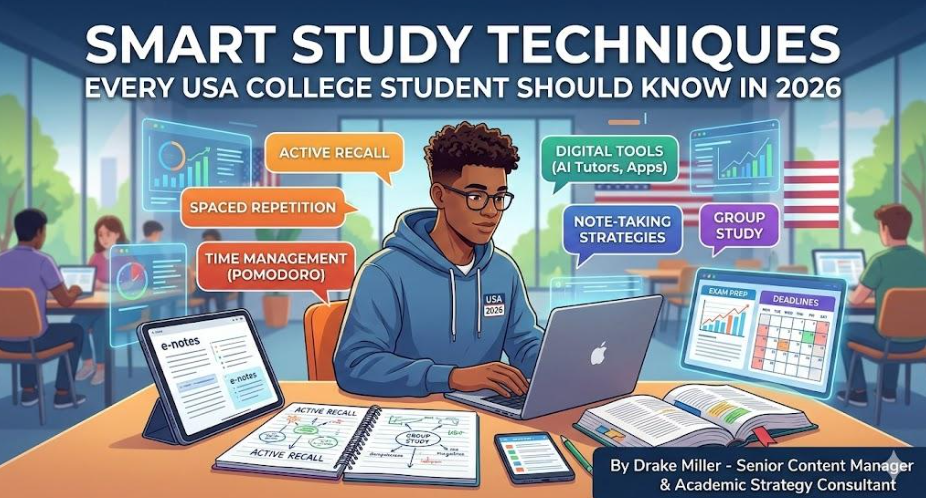
By Drake Miller – Senior Content Manager & Academic Strategy Consultant
The academic landscape in the USA has undergone a seismic shift as we move through 2026. With the integration of Agentic AI, hybrid learning models, and a fast-paced digital economy, the “old school” method of highlighting textbooks and pulling all-nighters is officially obsolete.
Today’s high school seniors and college students face more distractions than ever, but they also have access to more powerful, hyper-personalized tools. To stay ahead, you must move beyond “studying harder” and start “studying smarter.” Whether you are aiming for the Ivy League or crushing your finals at a state university, here is the definitive guide to smart study techniques in 2026.
1. Mastering the “Deep Research” Workflow
In 2026, the volume of information is no longer the hurdle; the challenge is Information Gain—finding unique insights amidst a sea of AI-generated filler. Smart students have moved from basic search queries to “Deep Research” workflows.
Instead of just skimming results, students now use multimodal AI assistants to synthesize research papers, university lectures, and podcasts into a single cohesive briefing. However, the key is not to let the AI do the thinking. Use tools to gather data, then apply Critical Analysis to verify facts. When the complexity of a 3,000-word thesis becomes overwhelming, seeking professional support from experts Myassignmenthelp.com can provide the structural guidance and research depth needed to turn a mediocre draft into an A-grade paper.
2. Active Recall 2.0: The Retrieval Practice
Science-backed research in 2026 has confirmed that “re-reading” is one of the least effective ways to learn; it creates an “illusion of competence.” The gold standard is now Active Recall, which involves testing yourself before you feel ready.
- Flashcard Automation: 2026 students use AI-driven platforms like Anki or Quizlet that utilize Spaced Repetition Systems (SRS) to predict exactly when your brain is about to forget a concept.
- The “Blank Sheet” Brain Dump: After a lecture, take a blank digital canvas and write down every single detail you remember. This “desirable difficulty” forces your brain to build stronger neural pathways, making the information permanent.
3. The Feynman Technique: Teaching as a Logic Check
One of the most effective ways to identify gaps in your knowledge is the Feynman Technique. The 2026 twist? Using AI as your “student.”
Explain a complex concept—like the nuances of literary criticism or Macroeconomic Policy—to an AI tool and prompt it to “act like a confused 10-year-old.” For students tackling complex humanities subjects, utilizing specialized English assignment help can further clarify these rhetorical strategies. If the AI asks a follow-up question you can’t answer in simple terms, you haven’t mastered the topic yet.
4. Biometric Study Sprints (The Evolution of Pomodoro)
The traditional 25-minute Pomodoro timer is a classic, but 2026 is the year of Biometric Study Sprints. Modern focus apps now sync with wearables to track your heart rate variability (HRV) and cognitive load.
- Data-Driven Focus: Instead of a rigid timer, work in 50-minute blocks when your biometric data shows you are at peak alertness.
- The 90-Minute Ultradian Rule: Your brain operates in 90-minute cycles. Pushing past this leads to “cognitive fatigue.” Align your hardest subjects with your morning “peak” and save administrative tasks for your afternoon “trough.”
5. Dual Coding: Merging Visuals with Narrative
In a world dominated by visual media, your brain craves more than just blocks of text. Dual Coding is the practice of pairing linguistic information with visual representations to create two distinct “hooks” in your memory.
Don’t just write notes about biological processes; use mind-mapping software like Miro or Coggle to connect the stages visually. By 2026, many students are using AI image generators to create custom infographics of their study notes, turning abstract concepts into memorable editorial illustrations.
See also: Maximize Your Marketing 328597200 Digital Tools
6. Interleaving: The Secret to Long-Term Mastery
Most students practice “blocked” studying—spending three hours on Calculus, then three hours on Physics. In 2026, top-performing students will use Interleaving.
Interleaving is the practice of mixing different topics or problem types in one session. For example, instead of doing 20 Algebra problems, do 5 Algebra, 5 Geometry, and 5 Calculus problems in random order. This forces your brain to constantly “reset” and figure out which strategy to apply, mimicking the unpredictable environment of a final exam.
7. Strategic Outsourcing and Mentorship
A “Smart” student in 2026 knows that time is their most valuable asset. With rising curricula standards, trying to be a solo expert in every niche is a recipe for burnout.
High-achieving students utilize academic resources early and often. Whether it’s attending a professor’s virtual office hours or leveraging the expert insights at Myassignmenthelp.com to understand complex rubrics and formatting standards, knowing how to delegate is a vital life skill. It’s not about taking a shortcut; it’s about optimizing your learning curve.
8. The “Sleep-Study” Connection
Neuroscience in 2026 has debunked “hustle culture” sleep deprivation. During REM sleep, your brain moves information from short-term “buffer” memory into long-term storage.
If you study for 10 hours and sleep for only 4, your brain physically cannot “write” that data to your long-term memory. Aim for a consistent 7–8 hours. If you have a massive exam, a 20-minute “power nap” immediately after a heavy study session can boost your retention by up to 20%.
9. Digital Minimalism and “Monk Mode”
Distraction is the ultimate enemy of the 2026 student. “Monk Mode” is a rising trend where students use software to block all social media, notifications, and internet access on their devices for set periods.
By eliminating the “switch cost”—the 23 minutes it takes your brain to refocus after checking a single text—you can finish in two hours what would normally take four. Tools like Forest or Freedom are essential for protecting your deep-work sessions.
Frequently Asked Questions
Q.1 What is the most effective study technique for 2026?
While individual styles vary, Active Recall combined with Spaced Repetition remains the most scientifically validated method.
Q.2 How can I use AI for studying without violating academic integrity?
Use AI as a tutor, not a ghostwriter. Use it to explain theories or create practice quizzes. For structural guidance and meeting high-level academic rubrics, consulting professional services Myassignmenthelp.com provides expert mentorship while keeping your original voice intact.
Q.3 Is the Pomodoro Technique still relevant?
The 25/5 split is a great entry point, but Biometric Study Sprints are more efficient for 2026 students as they adapt to your actual focus levels.
Q.4 Why is sleep considered a “study technique”?
Sleep is when Memory Consolidation occurs. Skipping sleep causes “cognitive leakage,” where you lose a significant portion of what you just worked to learn.
Conclusion: The 2026 Competitive Edge
The difference between a struggling student and a successful one in 2026 isn’t raw IQ—it’s methodology. By shifting from passive reading to active recall, leveraging AI as a collaborator, and knowing when to seek professional academic support, you can reclaim your time and boost your GPA.
Success in college is no longer about who spends the most time in the library. It’s about who uses the smartest tools to master the material efficiently. Ready to level up? Pick one technique—like Interleaving—and apply it to your very next study session. And if the workload ever feels like too much, remember that the experts at Myassignmenthelp.com are always ready to help you navigate the toughest assignments.
Author Bio: Drake Miller
Drake Miller is a senior content manager and academic consultant with over a decade of experience in higher education strategy and EdTech integration. Based in the USA, Drake specializes in helping university students navigate the complexities of modern curricula through evidence-based learning methodologies and AI-driven productivity hacks.